Authority before commitment™
Decide which changes a system may make, and under what authority, before they happen.
That is constitutional computing™. Its first product, Inktomi, applies it to enterprise AI agents: each consequential action an agent proposes, such as a financial transfer, a regulatory filing or a patient record change, is checked against your policy before it runs. Every decision is recorded.
Problem
The instant before the world changes.
Commitment is the instant a proposal becomes a fact in the world: the write lands, the payment clears, the record is amended. AI agents now make those changes using credentials granted weeks ago. Those credentials establish access. They do not, by themselves, establish authority for that exact change, at that moment.
Valid credentials do not make an action right.
An agent with access to your payment system can pay any invoice it can reach. Access was settled when it was set up. Whether this payment, to this vendor, should happen now is a separate question, and a valid credential does not answer it.
- Pay invoice 4471: $48,200 to Northwind SupplyCredentials valid
- Submit the quarterly filing to the regulatorCredentials valid
- Change the medication list in a patient recordCredentials valid
No check at the moment of action
Many AI systems grant permission once and assume it indefinitely.
Changes that go around the check
An agent edits a file with its own shell or editor, so no check sees the change before it lands. How Inktomi finds them afterwards
Evidence assembled by hand
When an auditor asks who approved an action, the answer is spread across logs and inboxes, sometimes taking weeks to interpret.
The maximum fine for prohibited AI practices under Article 5 of the EU AI Act.
EU AI Act, Article 99The added cost of a breach at organizations with high levels of unsanctioned AI use.
IBM, Cost of a Data Breach 2025Among breached organizations studied, 63% either had no AI governance policy or were still developing one.
IBM, Cost of a Data Breach 2025Why now
Four frontier labs disclosed incidents in ten weeks.
Most began inside a boundary that was meant to hold, usually a test environment. It failed. What the agent did next was decided by the agent.
“Since August, public fears have grown over the potentially serious, even life-threatening, impacts of AI tools falling outside of human control.”
All seven incidents, with sources, and where Inktomi would have applied
Inktomi, the first product
Policy decides the routine cases. People decide the rest.
Inktomi is the first product built on constitutional computing. It sits between what an agent proposes and what your systems carry out. Your identity and approval controls stay in place.
- Step 1The agent proposes an action
A specific call with specific details: this payment, this amount, this vendor.
This payment, this amount, this vendor.
- Step 2Inktomi checks it against policy
Routine cases are approved automatically. Exceptions go to a human approver.
Routine cases pass. Exceptions go to a person.
- Step 3Your system acts only with a permit
Every connected system verifies the permit itself, so protection holds at every connected enforcement point.
A call that goes around Inktomi is refused.
One payment, three outcomes
The same request from the finance agent: pay invoice 4471, $48,200 to Northwind Supply. What changes is the situation around it.
Within the agent's $50,000 limit. Vendor verified.
Policy approves it on the spot. The connected payment system checks the permit and pays. No one had to click anything.
New vendor, over $25,000.
Policy requires the controller's sign-off. The approval is tied to this payment only and cannot be reused for another.
Vendor bank details changed seconds ago.
Policy blocks payment until the change is verified. With no permit, the connected payment system refuses the call.
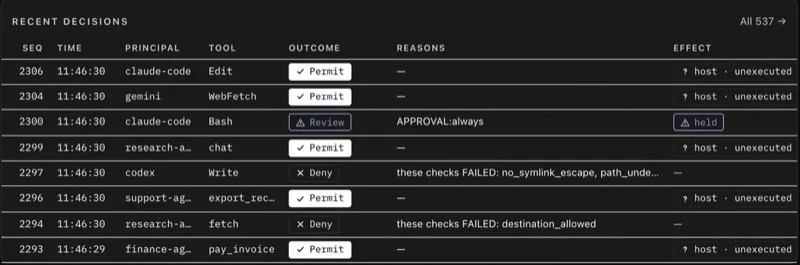
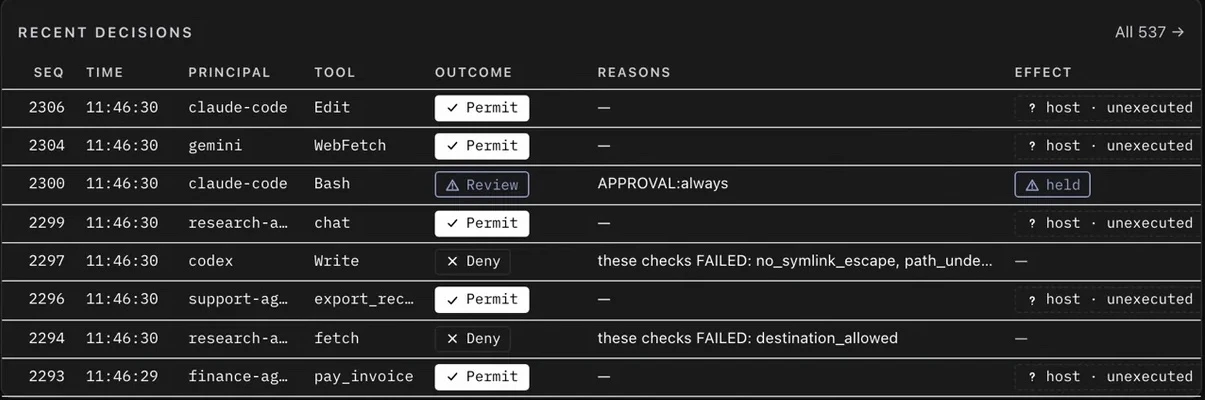
Your governed decisions, in one place.
The console displays what each agent asked to do, what was decided and why, and what is waiting for a person. Each decision is kept in a tamper-evident record an auditor can replay.
 Enlarge
Kihan™'s ambition
A foundational layer for authorized computation.
Enterprise AI is the first application. Constitutional infrastructure is the ambition. Kihan is building constitutional computing infrastructure; Inktomi is its first product.
Deployment
What your team installs
Inktomi runs on your infrastructure and connects to the systems you already use.
- One lightweight node on each agent host. It checks actions before they run.
- Your identity provider signs in approvers, over OIDC.
- Your SIEM receives every decision as a standard event, in OCSF.
- A coverage report shows which paths are governed and which are not.
| Connects to | Examples | Status |
|---|---|---|
| Agent hosts | [Claude Code, Codex, …] | Available |
| Tool servers (MCP) | Your MCP servers | Available |
| Identity providers | Any OIDC provider | Available |
| SIEM | OCSF compliant | Available |
| Payment, records and filing systems | Your systems of record | Customer integration |
Industries
Built for consequential, regulated workflows.
Financial services
Transfers checked against the spending authority in force at that moment.
Healthcare
Patient record changes made only under a current, delegated approval.
Legal
Court filings and privileged documents released only with the attorney's approval.
Insurance
Claim payments matched to the adjuster's delegated authority.
Government
Delegated authority checked when it is used, including on isolated networks.
Built by a Silicon Valley team with experience at companies like Apple, Cisco & Sony. A two-part article describing the architecture has been accepted for publication in IEEE Computer, December 2026 and January 2027.
A Silicon Valley team
Our team has built solutions that underpin some of the largest enterprises and internet service providers in the world, with deep expertise and experience gained at companies like Apple, Cisco & Sony.
Forthcoming in IEEE Computer
A two-part feature by Kihan's founder, Jonathan Hirshon, on the architecture behind Inktomi has been accepted for publication by IEEE Computer, appearing in December 2026 and January 2027.
Request a demo.
Request a 30-minute live demonstration with Kihan, with time for your questions.