AI proposes.
Authority decides.
Delegate more work to AI without delegating away control. Kihan builds constitutional computing: a mathematical architecture that separates what AI proposes from what it is authorized to do.
Inktomi™, our first product, analyzes each consequential action before it is committed—checking the authority to proceed and preserving the evidence of what was decided and why.
- Works with Claude Code, Codex, MCP
- Self-hosted
- Forthcoming in IEEE Computer
Access is not authority.
Access to a payment system does not, by itself, establish authority for a particular payment. Whether this payment, to this vendor, should happen now is a separate question.
Kihan separates capability from authority. Inktomi evaluates the proposed action before it takes effect, routes exceptions to the person who can authorize them, and leaves evidence of every decision.
Agents are getting decisions. Few get controls.
of day-to-day work decisions expected to be made autonomously by AI agents by 2028, up from none in 2024.
of agentic AI projects expected to be cancelled by the end of 2027. Inadequate risk controls are one of the three causes.
of breached organizations studied either had no AI governance policy or were still developing one.
For many Annex III high-risk systems, relevant EU AI Act obligations are scheduled to apply from 2 December 2027, including requirements concerning human oversight and record-keeping.
Proposal. Authorization. Enforcement.
One path leads to commitment. Where Inktomi enforces, every other path ends before it changes anything.
- 1
The agent proposes an action
A specific payment, filing or record change, with the facts needed to evaluate it.
- 2
Inktomi decides
The action is evaluated against the governing authority. Exceptions go to the person who can authorize them.
- 3
Only a permit commits
Each integrated tool verifies the permit before it acts. Without one, the call is refused. Every decision is kept as evidence.
Every governed decision, in one place.
The console shows what each agent asked to do, what was decided and why, and what is waiting for a person. Every decision is kept in a tamper-evident record, and replay derives it again, so an auditor checks the decision itself, not just a log of it.
In the self-hosted profile, every Inktomi component runs on your infrastructure. Approvers sign in through your identity provider, every decision reaches your SIEM as a standard event, and a coverage report shows which paths are governed and which are not.
1.22 msMedian time for the governance decision in Kihan’s benchmark harness. Not end-to-end latency, which an evaluation measures on your own path.
Explore the product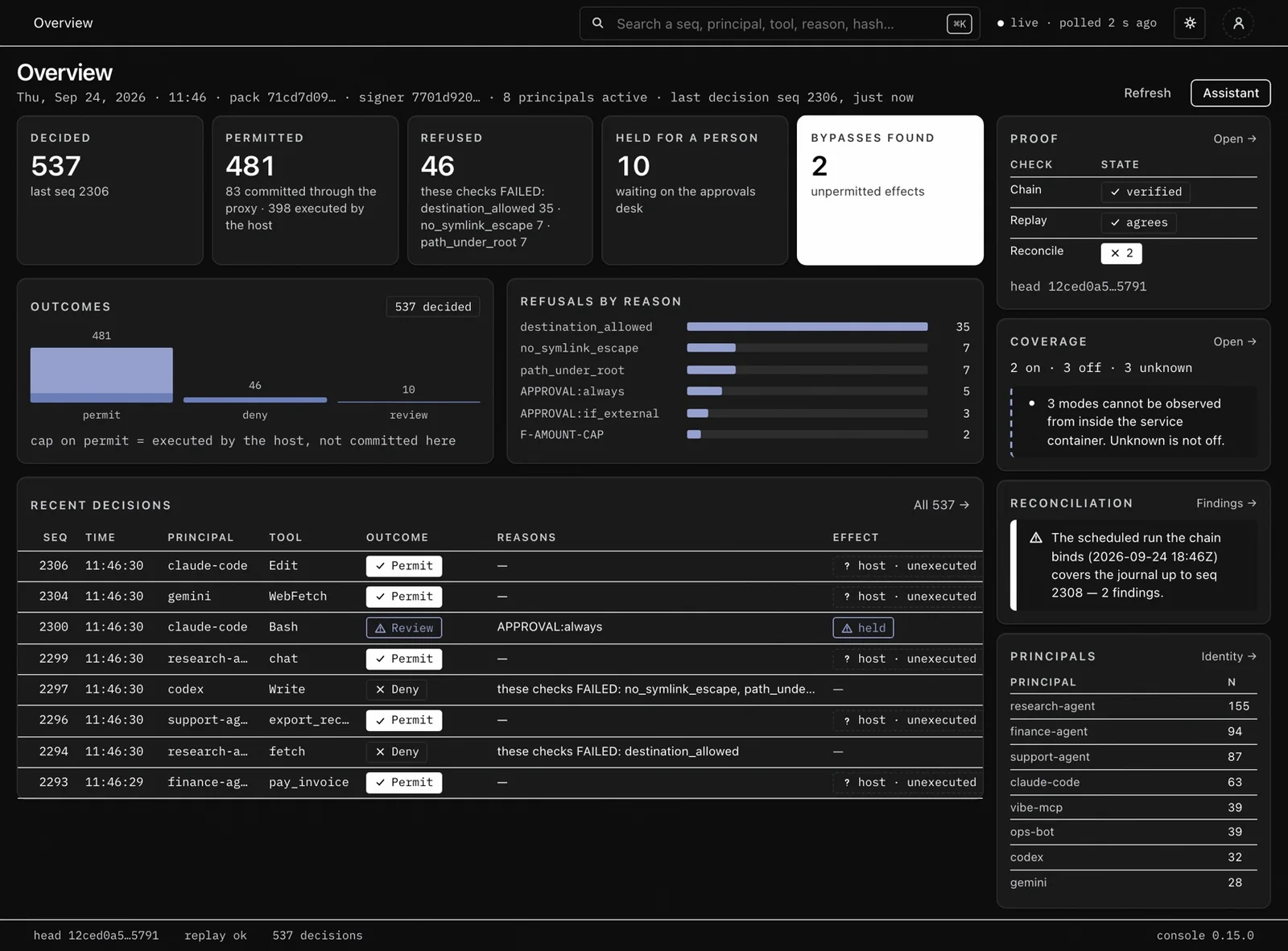
Built for consequential, regulated work.
The architecture is described in a two-part feature forthcoming in IEEE Computer, December 2026 and January 2027.
See it in 30 minutes.
A live demonstration, with time for your questions.